
Last Thursday, Baltimore County introduced the draft Data Center Study Report required by Bill 3-26 to the Planning Board. I’ve been studying it, and I wanted to share my thoughts on the recommendations.
First, I wanted to thank the Planning Board and the Study Workgroup for all their work on this. I also thank the stakeholders and members of the public who contributed testimony and expertise to the study. The testimony given by the public to the Planning Board during the public input meeting is summarized in the report. The issue of data centers, and the related issue of artificial intelligence with all the concerns it raises, may be among the biggest issues we are facing right now.
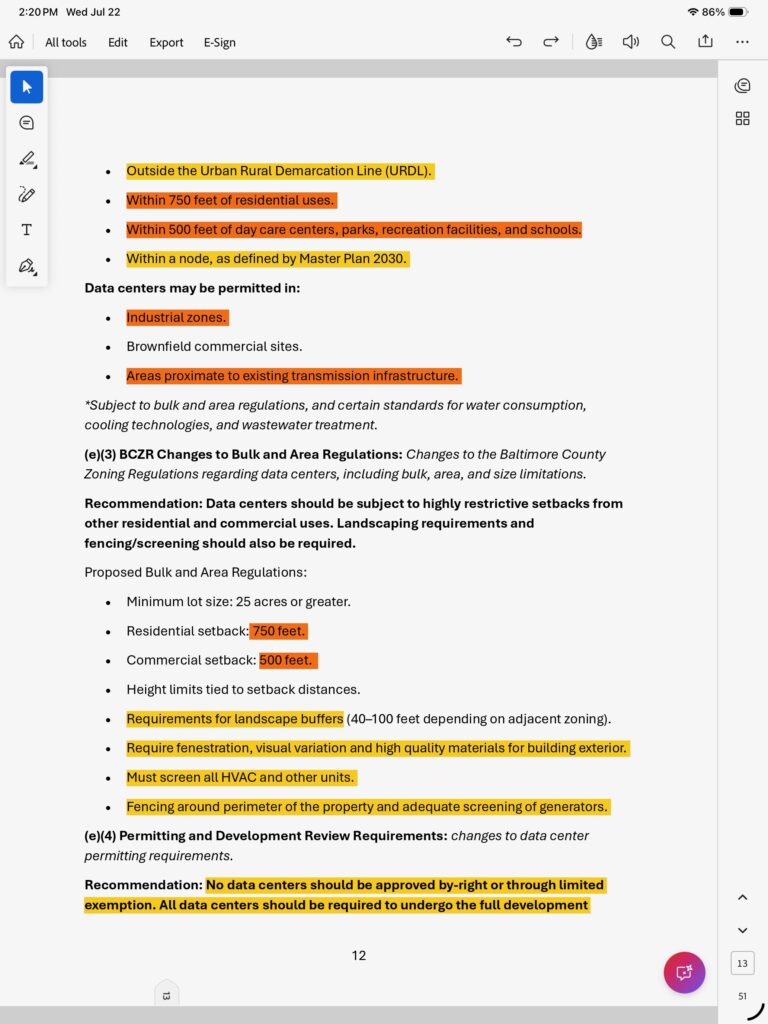
Here are my specific comments, with quotes and page numbers from the report. My comments are meant to apply to the larger, newer hyperscale data centers that are being built due to AI and other advanced application. Smaller data centers have been around for many years and don’t generally cause problems. The report says, “A definition should clearly differentiate on-premise data storage
facilities from larger scale data centers, such as colocation and hyperscale models.” (Page 14)
Electricity
One of the biggest concerns about data centers is the electricity that they consume. From the report:
Compared to other building types, data centers consume orders of magnitude more electricity per square foot. Benchmark data from the report shows grocery stores at 56.4 kWh/sq ft, laboratories at 32.1, and refrigerated warehouses at 29.6, while data centers can reach or exceed 2,500 kWh/sq ft. Put differently, a 100 MW data center could consume as much electricity as roughly 80,000 homes, highlighting a level of grid impact far beyond that of similarly sized industrial facilities. This disproportionate demand has already affected PJM auction prices and contributed to higher residential energy bills in the region. (Page 7-8)
The report rightly discusses demand on the electrical grid and the corresponding utility price increase as one of the biggest concerns. It’s important to note that this issue goes way beyond Baltimore County; because we are a part of the 13-state (plus DC) PJM grid, a hyperscale data center anywhere in any of those states, including in Baltimore County, will put increased demand on the grid and utility prices. This is a problem that Baltimore County alone cannot solve, even with a ban on hyperscale data centers. But Baltimore County needs to do our part to prevent or minimize impact on the electrical grid, as does every other jurisdiction within PJM.
The report says that “Baltimore County plays no role in energy regulation,” (Page 10) but it also notes “However, during the development review process, a data center developer should be required to submit verification of utility capacity, including contingencies for backup power, demand response, and load curtailment during grid stress events.” (Page 10)
The report recommends considering battery storage requirements, bring your own power generation and/or behind the meter generation. I think these type of requirements are a necessary baseline if we allow any hyperscale data centers to be built. However, I strongly oppose allowing building new gas generation plants to be allowed to fulfill any “bring your own” requirement. Natural gas, also called methane gas, is a major contributor to climate change, and gas plants also contribute to polluted air in the areas around the plant. The report mentions purchasing capacity from a private provider as an option, but this also should be required to be clean, non-polluting energy only.
Water
Baltimore County’s water pressure zones, reliance on City-owned infrastructure, and wastewater treatment limitations create additional siting constraints and require careful review during permitting. (Page 6)
The powerful servers used in modern hyperscale data centers tend to run extremely hot, and cooling is needed. Depending on the type of cooling implemented, data centers can use massive amounts of water. At the high end, hyperscale data centers using evaporative cooling can use 500,000 to as much as 5 million gallons of water per day! Some cooling types also need to discharge the used water into the environment or into the wastewater system. The report delves into different types of cooling and the pros, cons, and tradeoffs for each. The report recommends:
Unless using non-potable water, data centers should be required to use a closed-
loop cooling system, with a minimum water recycle rate. Data center developers should be
required to submit plans or projections for water usage and agree to an MOU or public
works agreement to memorialize water usage and mitigation efforts and make any public
works improvements necessary.
Closed-loop systems use far less water, although they do need to be refilled at times, but the tradeoff is that they use much more electricity. There is no perfect cooling system that doesn’t impact either water or the electric grid. Non-potable water puts less strain on the water system but will require mitigation for industrial discharge.
Siting/Land Use
Approvals for data centers should not be by right; rather, they should be subject
to the underlying zoning, bulk, area, and noise regulations, and certain standards for water
consumption, cooling technologies, and wastewater treatment. (Page 10)
I agree that if we allow data centers, they should never be “by right.” The county needs to consider the huge potential environmental and community impacts for each data center before approving it, and the public should have the opportunity, preferable more than one opportunity, to weigh in.
Data centers should be banned on rural land and open space, and limited to industrial zones. In rare cases, with highly restrictive standards and industrial adjacency, data centers could be permitted in
office or commercial zones. (Page 10)
and
Prohibit data centers on agricultural land, dedicated open space, and in close proximity to residential areas. Industrial zones preferable for data centers. (Page 11)
I agree that data centers should be banned on agricultural land and open space and in proximity to communities. However, land that is zoned industrial is not always ideal either, as these properties can be near communities. For example, 1500 Woodlawn Dr., which is the property where a developer wants to put a data center, is zoned ML IM (Manufacturing Light – Industrial Major), however it’s near a church, a mosque, a childcare center, residential communities, and the Social Security office complex, and is in an overburdened and underserved community. So regardless of the zoning, it would be an inappropriate place to locate a data center. One of the areas marked on the report’s maps as an area where data centers would be permitted under the report’s recommendations is the site of New Psalmist Baptist Church! I confirmed by looking at Baltimore County My Neighborhood that the property where New Psalmist sits is zoned Manufacturing Light, Restricted, considered an industrial classification.
For proposals in underserved and overburdened communities, approvals should be by special exception only and contingent on a community benefit. (Page 11)
I don’t believe that data centers should be allowed to be located in overburdened or underserved communities at all. “Overburdened” means that a community already has an excess of polluting facilities impacting the environment and quality of life, and adding a data center to that will multiply those impacts.
The report also states that data centers should be prohibited “within 750 feet of residential uses” and “within 500 feet of day care centers, parks, recreation facilities, and schools.” (Page 12) I do not believe that these setbacks are sufficient to mitigate the potential community impacts, including noise, pollution, poor aesthetics, and general degradation of quality of life.
“No data centers should be approved by-right or through limited exemption. All data centers should be required to undergo the full development process. In addition, data centers should be subject to noise and vibration studies, conducted before and after construction. (Page 12-13)
Yes to all of that!
“An additional public input meeting should be required prior to concept plan filing.” and “An additional meeting should be held earlier in the process, prior to filing a concept plan.” I agree with this! Current community input meetings held after a concept plan is filed are much too late in the process for something with such large potential impacts!
Baltimore County Zoning Regulations currently specify that data centers should only be permitted east of Pulaski Highway (Route 40) or south of Liberty Road. This provision should be struck and removed. (Page 11)
Yes yes yes! This provision was not fair and should never have been added. It needs to be struck.
Economic Impact
Data Center developments are being pitched to local governments as providing huge economic benefits. The report examines this claim, and finds that “data centers generate exceptional long-term tax revenue but very limited ongoing job creation, distinguishing them sharply from other industrial uses in economic development value.”
The revenue potential for data centers is significant, especially when many local governments are struggling with inadequate revenue to fully budget for their needs. The potential millions of dollars of property tax revenue could be used to build schools and infrastructure or fund education, public safety, or other needed programs. However, I would also caution Baltimore County to consider the costs that might offset that revenue, for example increased health costs, burden on the water system, or decreased property value (and thus decreased property tax revenue) for residential and commercial properties near the data center.
The report also notes that data center construction generates hundreds, if not thousands, of jobs during the construction phase, many of them good union jobs. Although these jobs are only in the community during the construction phase, it’s a benefit that can’t be discounted, particularly if data center construction could be tied to a requirement for some local hiring.
Incentives
The report says that “Data centers should not be eligible for County incentives.” I agree with this. With the ever increasing demands of AI, there is a high demand for places to build data centers, and no incentives are needed to attract them. In fact, should Baltimore County decide to allow data centers, the county is in the drivers seat and should use that to ensure that data centers are good neighbors.
Conclusions
The report puts forward a deeply thought out set of recommendations, and the County Council should consider these recommendations as a minimum baseline. The report’s recommendations would go a long way to protecting Baltimore County. However, in some cases I believe the County should go further:
- I believe the setbacks of 750 feet from residential uses and 500 feet from day care centers, parks, recreation facilities, and schools are too low to protect residents from the pollution, noise, and aesthetic impacts of data centers.
- Gas plants should not be allowed to fulfill any “bring your own energy” requirements. Burning gas contributes to pollution and climate change.
- The report recommends allowing data centers on industrial zones, “subject to standards.” Even with standards, there should still need to be development review and public input to ensure that the center would not impact nearby communities, which are in some cases not far from the industrial zones.
- The recommendations in the report require public input before concept plan submission. They also require transparency about things like water and electricity usage, as well as noise and vibration studies. All of these are great, but I’ll just say that the more transparency and public engagement on these, the better. I’m am looking into re-introducing my data center transparency bill for the 2027 session.
The maps at the end of the report showing areas that would be permitted or protected under the report’s recommendations show that these recommendations would protect most of the county from data center development. However, there are still some areas, even some potentially large areas, where data centers could be located.
In District 44B, the good news is that these recommendations would prevent the proposed Woodlawn data center from being built, because that area is inside a “place type node.” There are a couple of smaller areas in 44B where data centers could potentially be located: New Psalmist Baptist Church, as I noted above, and one on Lord Baltimore Drive. There is a large potential area in the south of the district, around I-895, Hollins Ferry Rd, and part of Washington Blvd. However, while this area is zoned industrial, I worry that it’s close enough to Halethorpe to impact the Halethorpe communities, and I will not allow Halethorpe to become a sacrifice zone.
I know that many people are calling for a complete ban of data centers, and that is certainly something that should be considered. However I don’t believe we are at that point yet. There will be a public input session on the report on September 3, and I think the County Council should carefully consider the analysis and recommendations in the Baltimore County Data Center Study, including taking a close look at whether there is actually any location in the county were a data center could be located without impacting communities, the public input on the report, and the Maryland State Data Center Study which is due later this year. I do think it’s necessary to extend the moratorium to consider all this information, and to allow the new incoming County Council and County Executive to make those decisions.
I have a lot of concerns generally about AI, but this post is long enough already, and that’s for another day. I’m not opposed to AI, I think it has some good uses, but every app, every web search now uses AI, whether we ask it to or not. And every time we use AI in the cloud, we’re using a data center somewhere, if not in our community then in someone else’s. As long as we as a society are going to use AI, and it seems that we are, then this is a problem we need to solve. I don’t know what the answers are, but for now I’m going to do everything I can to protect my communities.