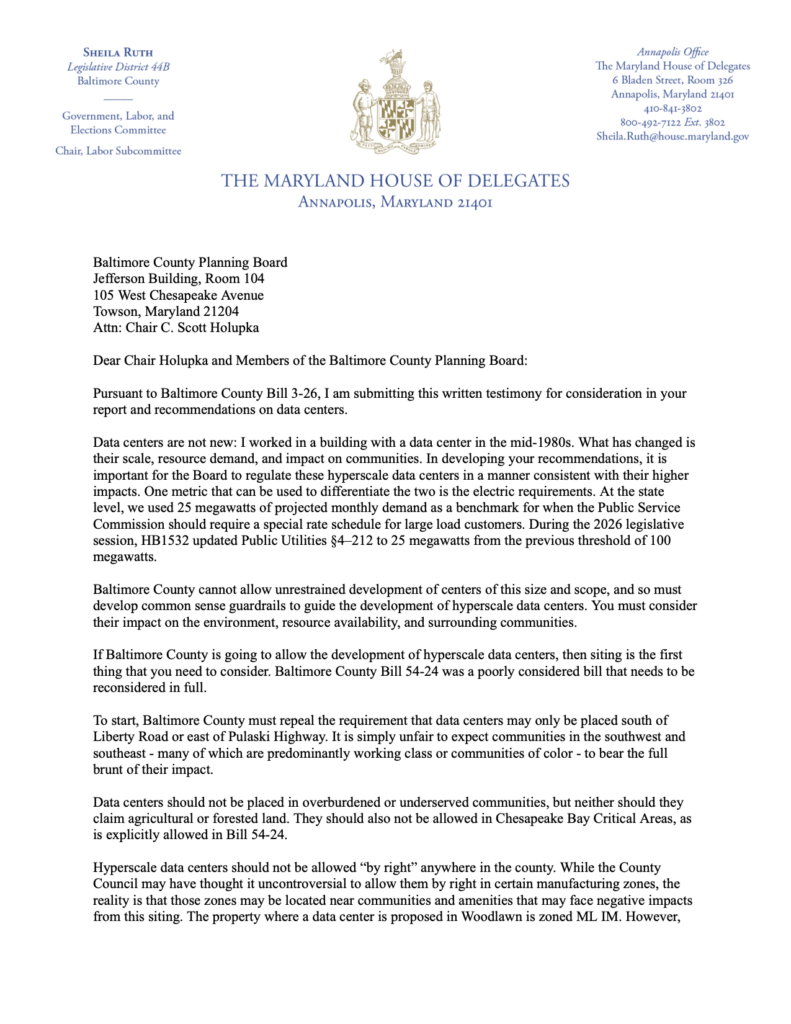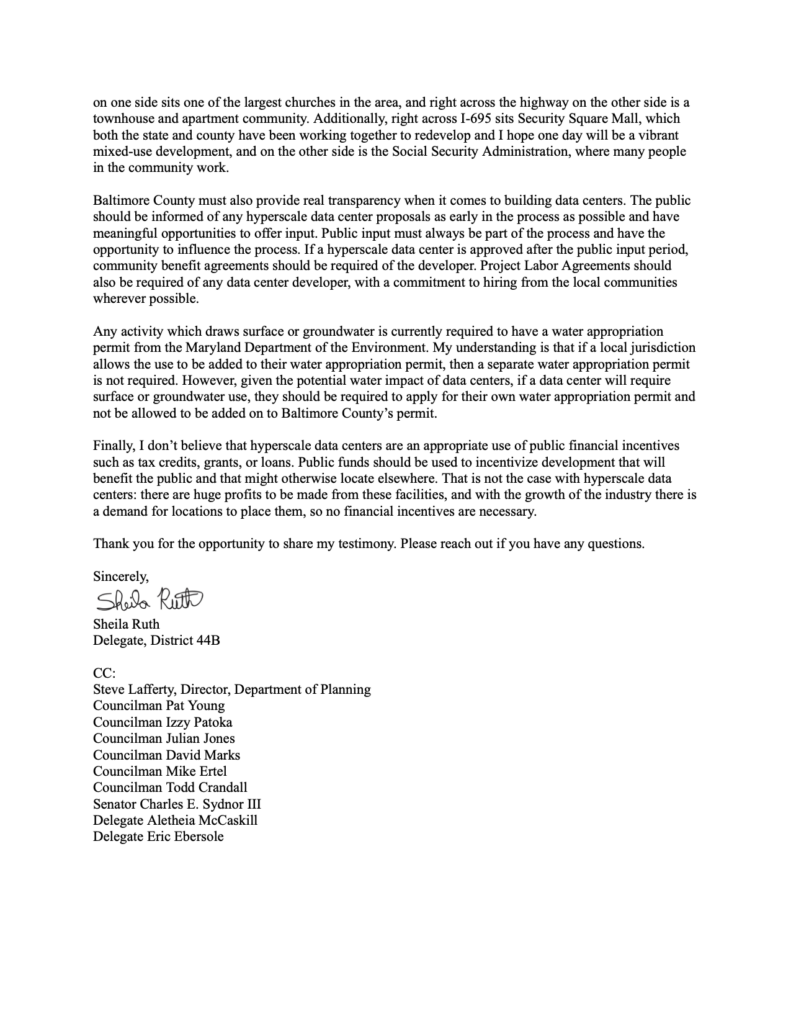
The Baltimore County Planning Board is conducting a study and report on recommendations regarding data center planning and requirements in Baltimore County, as required by County Council Bill 3-26: Zoning Regulations — Data Center Study. I submitted the testimony below. It’s not too late to submit your own comments on data centers in Baltimore County. You can email your comments to tbensley@baltimorecountymd.gov. Read more about the study here.
You can see my official letter in the images attached here, and here is the full text of the testimony:
Dear Chair Holupka and Members of the Baltimore County Planning Board:
Pursuant to Baltimore County Bill 3-26, I am submitting this written testimony for consideration in your report and recommendations on data centers.
Data centers are not new: I worked in a building with a data center in the mid-1980s. What has changed is their scale, resource demand, and impact on communities. In developing your recommendations, it is important for the Board to regulate these hyperscale data centers in a manner consistent with their higher impacts. One metric that can be used to differentiate the two is the electric requirements. At the state level, we used 25 megawatts of projected monthly demand as a benchmark for when the Public Service Commission should require a special rate schedule for large load customers. During the 2026 legislative session, HB1532 updated Public Utilities §4–212 to 25 megawatts from the previous threshold of 100 megawatts.
Baltimore County cannot allow unrestrained development of centers of this size and scope, and so must develop common sense guardrails to guide the development of hyperscale data centers. You must consider their impact on the environment, resource availability, and surrounding communities.
If Baltimore County is going to allow the development of hyperscale data centers, then siting is the first thing that you need to consider. Baltimore County Bill 54-24 was a poorly considered bill that needs to be reconsidered in full.
To start, Baltimore County must repeal the requirement that data centers may only be placed south of Liberty Road or east of Pulaski Highway. It is simply unfair to expect communities in the southwest and southeast – many of which are predominantly working class or communities of color – to bear the full brunt of their impact.
Data centers should not be placed in overburdened or underserved communities, but neither should they claim agricultural or forested land. They should also not be allowed in Chesapeake Bay Critical Areas, as is explicitly allowed in Bill 54-24.
Hyperscale data centers should not be allowed “by right” anywhere in the county. While the County Council may have thought it uncontroversial to allow them by right in certain manufacturing zones, the reality is that those zones may be located near communities and amenities that may face negative impacts from this siting. The property where a data center is proposed in Woodlawn is zoned ML IM. However, on one side sits one of the largest churches in the area, and right across the highway on the other side is a townhouse and apartment community. Additionally, right across I-695 sits Security Square Mall, which both the state and county have been working together to redevelop and I hope one day will be a vibrant mixed-use development, and on the other side is the Social Security Administration, where many people in the community work.
Baltimore County must also provide real transparency when it comes to building data centers. The public should be informed of any hyperscale data center proposals as early in the process as possible and have meaningful opportunities to offer input. Public input must always be part of the process and have the opportunity to influence the process. If a hyperscale data center is approved after the public input period, community benefit agreements should be required of the developer. Project Labor Agreements should also be required of any data center developer, with a commitment to hiring from the local communities wherever possible.
Any activity which draws surface or groundwater is currently required to have a water appropriation permit from the Maryland Department of the Environment. My understanding is that if a local jurisdiction allows the use to be added to their water appropriation permit, then a separate water appropriation permit is not required. However, given the potential water impact of data centers, if a data center will require surface or groundwater use, they should be required to apply for their own water appropriation permit and not be allowed to be added on to Baltimore County’s permit.
Finally, I don’t believe that hyperscale data centers are an appropriate use of public financial incentives such as tax credits, grants, or loans. Public funds should be used to incentivize development that will benefit the public and that might otherwise locate elsewhere. That is not the case with hyperscale data centers: there are huge profits to be made from these facilities, and with the growth of the industry there is a demand for locations to place them, so no financial incentives are necessary.
Thank you for the opportunity to share my testimony. Please reach out if you have any questions.
Sincerely,
Sheila Ruth
Delegate, District 44B